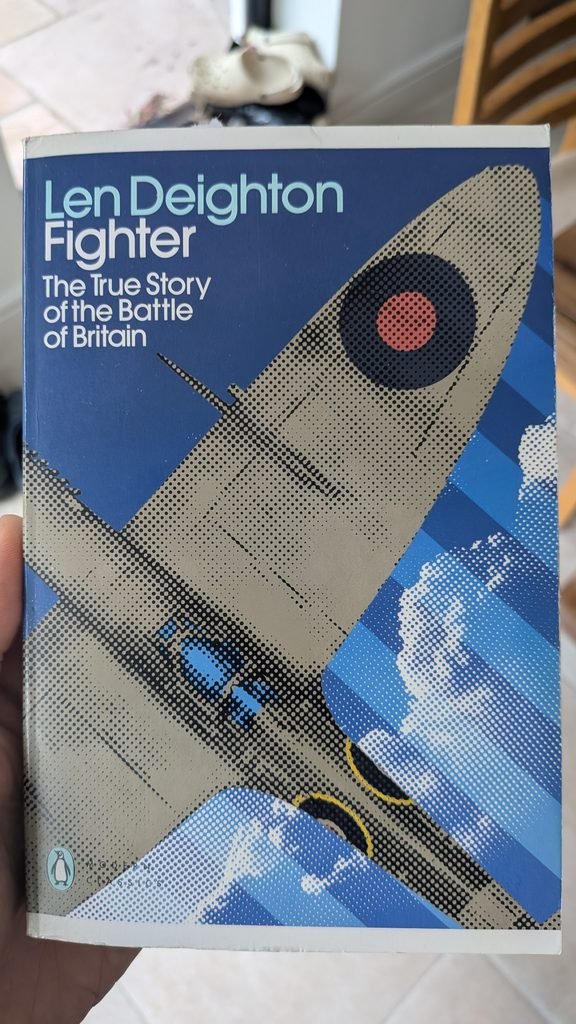
I’ve read a few of Deighton’s spy thrillers, but hadn’t heard of his non-fiction output until browsing his Wikipedia entry. Fighter is his labour of love (obviously huge depth of research) into the Battle of Britain.
He attacks the subject from a position of impartiality, indicating previously biased works and those partly based on myth and legend have annoyed him.
He provides in depth background to the personnel and equipment involved in the battle… I wasn’t expecting such fine detail but then again I haven’t read too many detailed military histories of battles so I guess this is likely standard. It’s clear that for all the patriotic love of the Spitfire, the Hurricane was an equal contributor to success, and the German fighter planes such as the BF 109s were a very close match.
As with many of the events that are woven into the collective British memory, I was a little fuzzy on the Battle of Britain. The Luftwaffe’s aim was also slightly vague, but largely was to prepare the way for a Nazi invasion of Britain. This meant a combination of reducing/destroying RAF Fighter Command, taking out air bases, destroying key radar installations, targeting important factories, and breaking the nascent radar capabilities. But priorities were unclear, one of the key reasons the Germans failed.
Deighton weighs up all the evidence and is equally scathing of the British and the Germans when required. Goring didn’t take the strategic steer of pre-war planning, and didn’t specify the vulnerable British aero industry as a primary target.
The British effectiveness was boosted by excellent collaboration between military, business, and science, and more overall coordination. The German’s on the other hand were more siloed, and of course limited their academic input by anti-Semitic policy. Killing all your greatest Jewish minds (or encouraging them to flee) isn’t the best approach to scientific progress.
“Scores” or fighter pilot kills of enemy planes, were greatly exaggerated by both sides (by a factor of around two) while losses were downplayed. The RAF were somewhat worse in this regard when post-war records are analysed. Also interesting that of the top 10 RAF pilots, only two were British with the rest being Polish, Czech, Australian, French etc.
The harsh treatment of two senior British Airways Vice-Marshals Dowding and Park immediately after the Battle of Britain, driven by political shenanigans, is particularly galling. And not everyone was a hero – some airfields, after undergoing sustained bombing, saw the ground crews hiding in bunkers and refusing to leave.
Ultimately this was a battle of attrition, with horrendous losses and huge efforts on both sides; the Brits just had to somehow survive the summer, until the weather turned and delayed the Nazi invasion. Thankfully, they did just that.