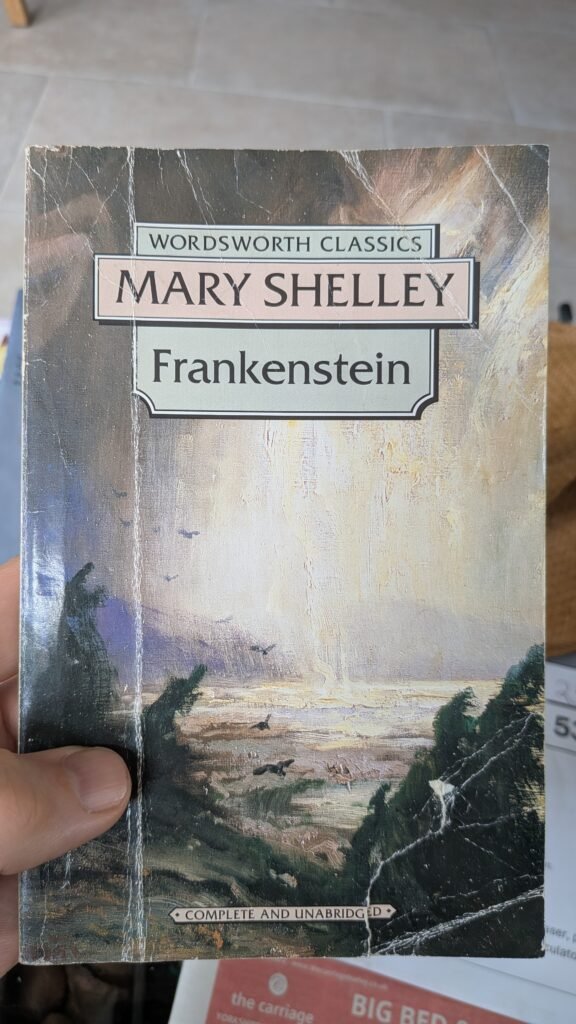
Another week, another classic. Pulled from our shelves, sitting there for years just waiting to be read… the original science fiction horror novel – Frankenstein.
Firstly, it’s short, just 160 odd pages. Secondly it is told as a series of stories, first the explorer Walton who picks up Frankenstein in the frozen north pursuing a strange and huge figure. Then Frankenstein himself recounts his backstory to Walton. Then within that tale, the monster itself fills in the missing gaps by telling Frankenstein of its own adventures.
One thing I noted, given the enormous association of the term Frankenstein, is that apart from the title, the main character’s name barely appears in the text. I don’t even think it is used until a decent way through the story, and yet is now inseparable from the entire genre.
There is very little description of the monster; barely anything describing its creation (in fact there is a part where Frankenstein actively rejects explaining for fear his work will be replicated), and only smatterings of its appearance.
It’s very aristocratic gentleman-esque in the sense that the characters can swan off for months travelling, spend waiting for each other or letters, and generally do anything other than work. There’s a slightly bizarre travelogue in the middle of the book as Frankenstein and his best friend travel from Europe to Scotland, with reviews of key tourist sights en route.
But the central premise of man acting as god, trying to create life but instead creating a monster that then destroys what he loves, is brilliant. There are obvious parallels in every period of history – for 2026 see AI.
And sympathy for the monster, which did not ask to be created and was given no support by Frankenstein, is clear even taking account for its sins. The lack of forethought about what to do if/when his monster sparked into life is in stark contrast to the enormous amount of effort, emotion, and pain Frankenstein expends in his attempt to exterminate it also has echoes of the ratio of strategy and planning that went into the US/Iran conflict.
Clearly an amazing book when all these contemporary thoughts pop into ones head when reading words over 200 years old.