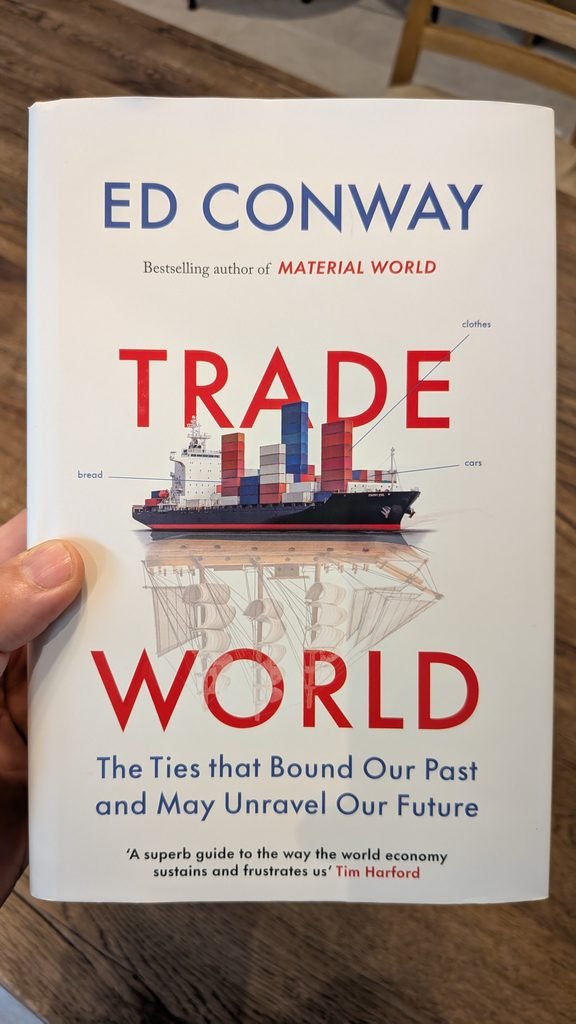
Ed Conway’s previous book Material World was fascinating, and so I ordered a pre-sale copy of this latest fully confident it would be equally enlightening.
This time he covers international trade, historical and current, plus a worrying nod to the future. Three example products are used to walk us though this complex arena: bread, clothes, and cars.
Bread allows insights into commodities (different varieties of wheat traded internationally), mechanisation (the amazing Chorleywood bread process that British scientists created to speed up production), and tariffs/barriers (the UK Corn Laws that restricted imports unless domestic prices hit certain thresholds, resulting in artificially high prices and shortages).
The clothing lens expands on these themes, with automation of almost every step of the fabric production process (protested at one stage by the famous Luddites), adding middlemen into the mix (Li & Fung of Hong Kong who connected Western Firms with the vast array of supplier/factories in Asia) and also the disgraceful behaviour of colonial Britain in both the slavery trade and the Opium wars (where Britain and France fought and beat China for the right to sell addictive drugs to the Chinese market, resulting in the legalisation of opium and the taking of Hong Kong).
The third section covering car manufacturing reinforces the lesson that practically nothing is made in one place, but is instead the final step in an enormously complex supply chain of components that have been made all over the world.
The book ends with three fairly worrying points. Firstly, that over the past few decades China has built up the knowledge, skills, and capabilities to make pretty much everything from the most basic to the extremely complex. Secondly, that this at best may lead to further societal problems in the West as more jobs are lost, at worst could be leveraged aggressively as we become more dependent on Chinese output. And thirdly, that unlike in previous wars, Britain has far lower onshore manufacturing skills that could pivot to supply war economy needs if the shit really does hit the fan.
So a really well written and interesting book that becomes quite dark in the final chapter…